
As the United States pushes to expand domestic energy production and fortify its bioeconomy, securing reliable sources of biomass is a top priority. Traditional annual energy crops like corn or sorghum can be vulnerable to shifting weather patterns, introducing risk into the national energy supply chain. To build a more resilient energy landscape, researchers are looking to hardy perennial grasses like Miscanthus and switchgrass.
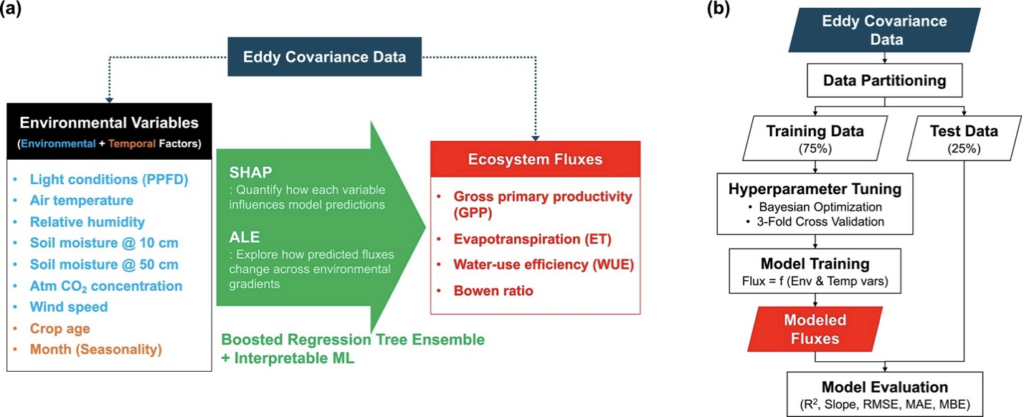
A new study has successfully combined long-term field observations with advanced artificial intelligence to analyze how different bioenergy crops manage carbon, water, and energy. By processing 55 site-years of high-frequency data from the University of Illinois Energy Farm, the researchers used interpretable machine learning to reveal exactly how perennial crops outperform traditional annual crops during climate volatility. The results offer a data-driven blueprint for stabilizing and scaling up domestic biomass production.
Key Breakthroughs for Domestic Energy Resilience
- Built-In Climate Buffering: The AI-driven framework revealed that perennial grasses possess a powerful “physiological buffer”. Thanks to deeper root networks and enduring leaf structures, crops like Miscanthus can sustain high growth rates across a much wider range of temperatures and moisture conditions than annual crops.
- Stability Over Annual Fluctuations: While annual crops suffer sharp drops in growth and productivity when confronted with low humidity or sudden soil moisture deficits, perennials maintain steady output. This predictability is vital for agribusinesses that require a steady, uninterrupted supply of energy feedstocks.
- Smarter Landscape Design via Machine Learning: By utilizing state-of-the-art machine learning models (such as Shapley Additive Explanations and Accumulated Local Effects), scientists can now pinpoint the precise environmental thresholds that trigger or limit crop productivity. This allows energy planners to strategically deploy the right crops to the right regions for maximum localized yield.
By demonstrating that a shift toward perennial bioenergy feedstocks provides superior climatic resilience and reliable biomass volume, this study gives agricultural producers and energy stakeholders the tools they need to comfortably expand the American bioenergy sector.
Study Details & Metadata
- Article Title: Contrasting Carbon–Water–Energy Dynamics in Perennial and Annual Bioenergy Agroecosystems Using Eddy Covariance and Interpretable Machine Learning
- Journal: GCB Bioenergy
- DOI: 10.1111/gcbb.70156
- Funding & Support: This work was supported by the Center for Advanced Bioenergy and Bioproducts Innovation (CABBI), a Bioenergy Research Center funded by the U.S. Department of Energy (DOE). It is published as an open-access article.
- Principal Investigator Contact: Carl J. Bernacchi – bernacch@illinois.edu
AI Acknowledgement: This summary was prepared with the assistance of an AI collaborator.