To strengthen U.S. energy security and expand domestic supply chains, scaling the commercial production of bio-based fuels, chemicals, and specialty products is essential. Non-food feedstock crops grown across the nation offer an abundant supply of plant biomass, but converting these complex feedstocks into market-ready commercial goods faces technical and economic barriers. Conventional precision fermentation platforms often depend on expensive, refined sugars and costly downstream purification steps, limiting their economic viability at a commercial scale.
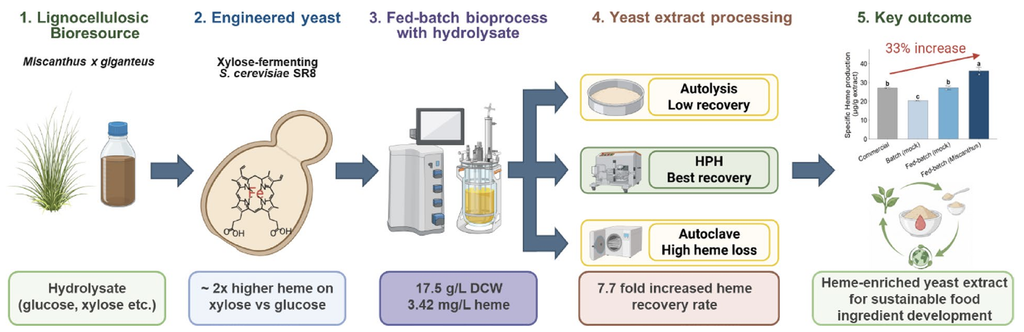
A new study demonstrates a streamlined bioprocess to convert Miscanthus x giganteus directly into a heme-enriched yeast extract by using an engineered strain of Saccharomyces cerevisiae. The researchers established a scalable blueprint to expand the range of valuable commercial products manufactured from domestic biomass through optimizing fed-batch fermentation to harness the unique sugar profile of lignocellulosic hydrolysates and identifying mechanical disruption strategies for downstream recovery.
Key Breakthroughs for the U.S. Domestic Biomass
- Harnessing Sugars: Cultivating engineered S. cerevisiae yeast on xylose stimulated respiratory metabolism and mitochondrial activity. This metabolic shift doubled intracellular heme concentration compared to standard glucose fermentation.
- Fed-Batch Bioprocessing Maximizes Sugar Yields: Controlled feeding of Miscanthus × giganteus hydrolysates prevented sugar overflow metabolism. This strategy promoted high biomass density and increased total volumetric heme production by 37% over mock sugar formulations.
- Targeted Processing for Product Recovery: The study identified downstream recovery as a critical factor in manufacturing yeast extracts, proving that high-pressure homogenization yields a 7.7-fold increase in soluble heme recovery compared to traditional autolysis methods.
By successfully converting non-food lignocellulosic crops into functional, heme-enriched yeast ingredients, this research highlights a key pathway for expanding the commercial product portfolio derived from U.S. feedstock crops. Refining these precision fermentation and downstream recovery bioprocessing techniques will bolster domestic manufacturing capabilities, supporting a robust and resilient U.S. bioeconomy built on home-grown feedstocks
Study Details & Metadata
- Article Title: Valorization of Miscanthus giganteus hydrolysates into heme-enriched yeast biomass and extract using xylose-fermenting Saccharomyces cerevisiae
- Journal: Bioresources and Bioprocessing
- DOI: 10.1186/s40643-026-01133-1
- Funding & Support: This work was supported by the Center for Advanced Bioenergy and Bioproducts Innovation (CABBI), a Bioenergy Research Center funded by the U.S. Department of Energy (DOE). It is published as an open-access article.
- Principal Investigator: Yong-Su Jin – ysjin@illinois.edu
AI Acknowledgement: This summary was prepared with the assistance of an AI collaborator.