
Expanding domestic energy production and the commercial manufacturing of fuels and products rely heavily on high-yielding perennial crops like Miscanthus. However, a major bottleneck to scaling up commercial supply chains in temperate regions is winter-kill, particularly during a young crop’s vulnerable first year and following severe freezing events. Existing commercial cultivars lack the cold tolerance required to thrive across northern regions, like U.S. Midwest and Northeast, threatening reliable feedstock yields and grower investments.
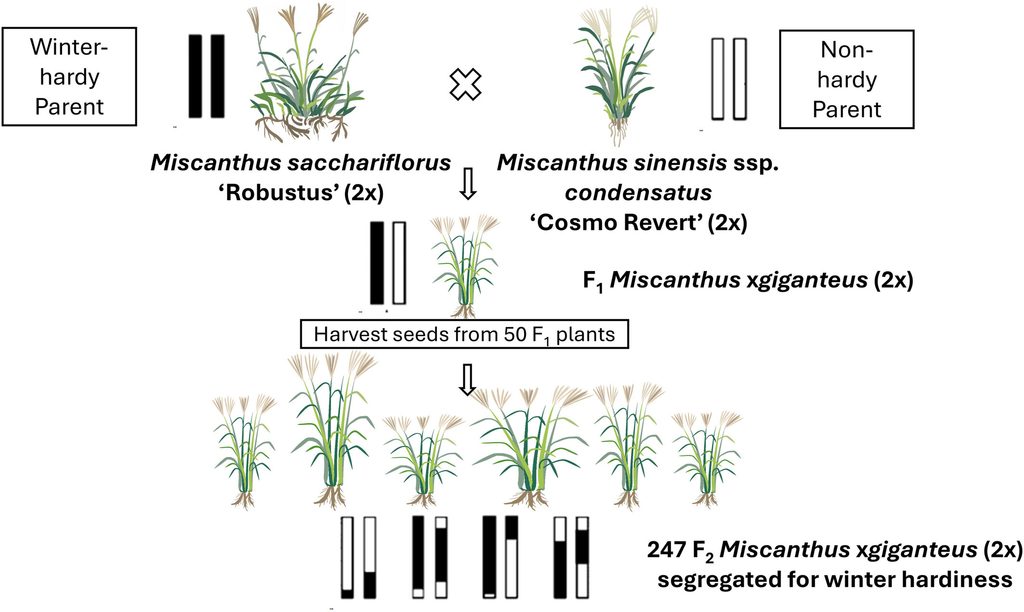
In a new study, researchers investigated the genetic architecture underlying winter-hardiness using a specially crossed F2 population derived from winter-hardy parent (M. sacchariflorus ‘Robustus’ with a non-hardy parent (M. sinensis ssp. condensatus ‘Cosmo Revert’). By combining high-density linkage mapping and genome-wide association studies across multiple field seasons, including an extreme freeze induced by a polar vortex, the study identified genetic regions and candidate genes responsible for cold survival and regrowth, establishing a clear pathway for breeding climate-resilient crops.
Key Breakthroughs for Winter-Hardy Feedstock Crops
- Hardy-Parent Alleles Consistently Drive Survival: Across all 37 quantitative trait loci (QTLs) detected for winter survival, hardiness, and vigor, genetic variants inherited from the hardy M. sacchariflorus parent consistently enhanced winter survival and post-freeze regrowth, whereas alleles from the non-hardy parent decreased hardiness.
- Distinct Mechanisms Govern Young vs. Mature Plants: The study revealed largely non-overlapping QTL sets between first-year establishment survival and fourth-year mature-plant hardiness. This demonstrates that different physiological and genetic strategies, such as axillary bud protection and cold acclimation, underlie winter survival as plants mature.
- Genomic Blueprint Enables Accelerated Breeding: Researchers pinpointed 14 primary candidate genes linked to cold tolerance, including cell membrane guardians and stress-responsive regulators. High trait heritability means marker-assisted selection can dramatically speed up the development of winter-hardy cultivars.
These genetic discoveries provide actionable tools for breeders to deploy marker-assisted selection, accelerating the development of robust, winter-hardy Miscanthus cultivars. By ensuring reliable crop establishment and high biomass yields in colder climates, this research removes key supply chain vulnerabilities and supports the large-scale commercial production of domestic fuels, chemicals, and products.
Study Details & Metadata
- Article Title: Genetic Mapping for Winter-Hardiness in a Miscanthus sacchariflorus × M. sinensis (Hardy × Non-Hardy) $F_2$ Population
- Journal: Global Change Biology Bioenergy
- DOI: https://doi.org/10.1111/gcbb.70175
- Funding & Support: This work was supported by the Center for Advanced Bioenergy and Bioproducts Innovation (CABBI), a Bioenergy Research Center funded by the U.S. Department of Energy (DOE). It is published as an open-access article.
- Principal Investigator Contact: Erik Sacks – esacks@illinois.edu
AI Acknowledgement: This summary was prepared with the assistance of an AI collaborator.