Data for Unintended Consequences of Biomass Markets and Implications for Nitrate Reduction Policy
Themes: Sustainability
Keywords: Agroecosystem, Biomass Analytics, Economics, Energy crops, Geospatial, Nitrate Loss, Technoeconomic Analysis
Citation
Overview
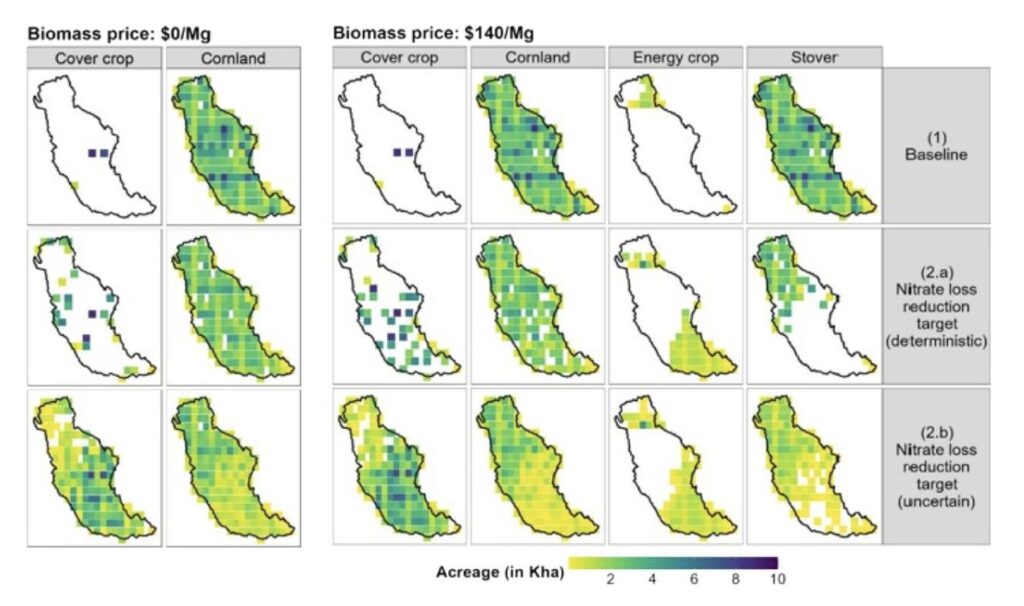
scenarios, with cornland and stover acreages shown referring to
land without cover cropping.
Energy crops are considered a promising approach to reduce nitrate (NO3) loss to groundwater and surface water from cropland, but they are costly to adopt and will require biomass market-based payments and/or policy incentives to induce production. We developed a spatially explicit integrated economic and biophysical model to assess the implications of biomass markets at various biomass prices for nitrate loss in the Raccoon River Basin, Iowa. We also examine the cost-effectiveness of alternative policy approaches to achieve nitrate loss reduction, including a nitrate price and/or a corn stover harvesting ban, and compare the effects of considering nitrate loss to be deterministically determined or being stochastic. We find that high biomass prices are needed to increase energy crop adoption and that low biomass prices induce corn stover harvesting, which creates incentives to expand nitrogen (N)-intensive continuous corn systems and have a deleterious effect on water quality. The introduction of biomass markets needs to be accompanied by the imposition of a nitrate price to achieve targeted nitrate loss reduction cost-effectively; the cost of achieving the target increases with biomass prices, the imposition of a corn stover harvesting ban, and the consideration of weather-related uncertainty in nitrate loss reduction. These findings show the need for designing appropriate policy incentives to avoid the unintended consequences of biomass markets as the sole mechanism for incentivizing energy crops to achieve water-quality goals in a watershed.
Data
Illinois Data Bank: Nitrate loss maps, underlying geospatial layers, python and R code to reproduce figures.