Data for Selective Oxidation of 3-Hydroxypropionic Acid to Malonic Acid over Pd/C: Mechanistic and Kinetic Study
Themes: Conversion
Keywords: Bioproducts, Catalysis
Citation
Kim, S.Y., Chavarrio, J.E., Install, J., Huber, G.W. Jan. 6, 2026. Data from: “Selective Oxidation of 3-Hydroxypropionic Acid to Malonic Acid over Pd/C: Mechanistic and Kinetic Study.” University of Illinois Urbana-Champaign. DOI: 10.13012/B2IDB-8287385_V1.
Overview
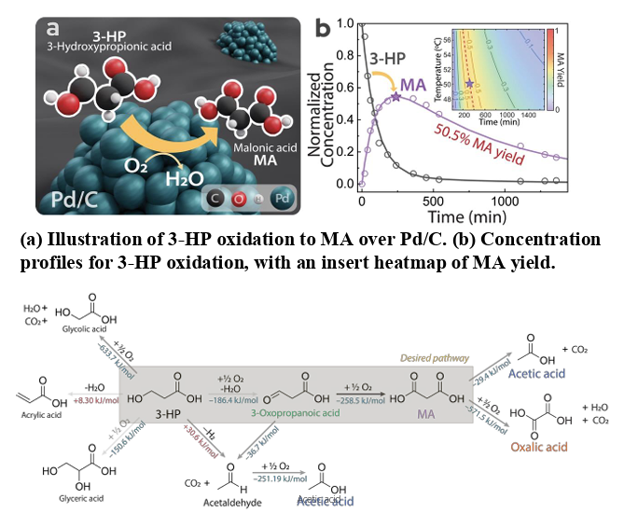
Malonic acid (MA) is a high-value dicarboxylic acid with strong industrial demand, yet its current production heavily relies on petrochemical feedstocks. Here, we report the first systematic study for the sustainable production of MA via oxidation of 3-hydroxypropionic acid (3-HP) with a Pd/Carbon catalyst. The effects of oxidant type (O2 and H2O2), pH, and temperature on the reaction chemistry were comprehensively evaluated. Guided by experimental observation and DFT-calculated thermochemical energetics, reaction networks for 3-HP oxidation with both oxidants are proposed and validated through kinetic modeling. MA was identified as the primary oxidation product, while further oxidation yields acetic acid and oxalic acid. The kinetic model validated the network, displaying excellent agreement (R2 > 0.95). Kinetic observations also enabled a direct comparison between O2 and H2O2 and revealed their distinct behaviors. The model was further developed into a temperature-time map, providing insight into conditions that maximize MA production. Malonic acid selectivity of 56.9 % and yield of 50.5 % were achieved at 3 bar oxygen, equimolar NaOH:3-HP ratio, and 50 °C.
Data
Illinois Data Bank: Optimized conditions, oxidation results, transport criteria, catalyst characterization, computer rate constants, calculated reaction orders
Dryad: Model code and data