Data for Selective Designer Hydrolysates from Miscanthus Bioenergy Crop for Sustainable Utilization
Themes: Conversion
Keywords: Biorefinery, Feedstock Bioprocessing, Hydrolysate, Lipids, Miscanthus, Perennial Bioenergy Grasses
Citation
Singh, S., Raj, T., Ye, J., Jagtap, S., Yang, C., Rao, C., Singh, V. Aug. 5, 2026. “Data for Selective Designer Hydrolysates from Miscanthus Bioenergy Crop for Sustainable Utilization.” University of Illinois Urbana-Champaign. DOI: 10.13012/B2IDB-7657959_V1
Overview
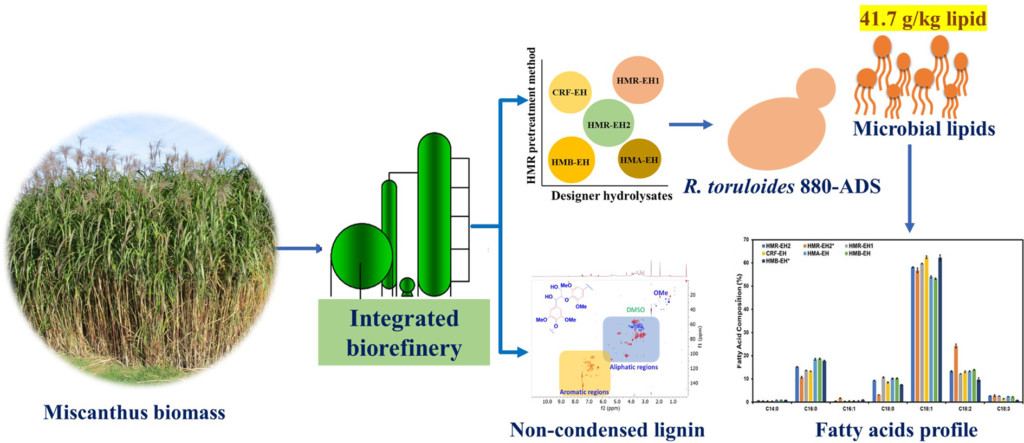
Designer enzymatic hydrolysates deliver targeted, optimized fermentable sugars while reducing the formation of inhibitory by-products. Herein, five distinct enzymatic hydrolysates (EH) were generated from Miscanthus biomass using an alkaline-ethanol fractionation and hydrothermal mechanical refining (HMR) pretreatment approaches. Noticeably, alkali-ethanol fractionated hemicellulose A (HMA) and hemicellulose B (HMB) hydrolysis resulted in xylose-rich enzymatic hydrolysates with 104.8 ± 5.6 g/L and 173.4 ± 4.6 g/L xylose, respectively. All five hydrolysates encompassing varied carbon to nitrogen ratio were evaluated for lipid production using an engineered oleaginous yeast, R. toruloides 880-ADS. Microbial fermentation of xylose rich hydrolysates, viz. HMR-EH2, HMA-EH, and HMB-EH resulted in lipid yields ranging from 0.05 to 0.12 g/g sugar. Compositional and 2D NMR analysis revealed that HMA-EH residues are highly lignin-enriched, while preserving the non-condensed structure conducive to valorization. Overall, findings highlighted a novel, selective trade-offs approach for maximizing lipid titers from designer hydrolysates, corroborating complete resource recovery for establishing integrated biorefineries.
Data
Illinois Data Bank: Sugar composition, cell density, and lipid production profiles of RT880-ADS grown on five hydrolysates, FAME composition, 2D-HSQC NMR contour plots of Miscanthus lignin samples, solid loadings effects, compositional analysis of biomass fractions, and designer hydrolysate compositions