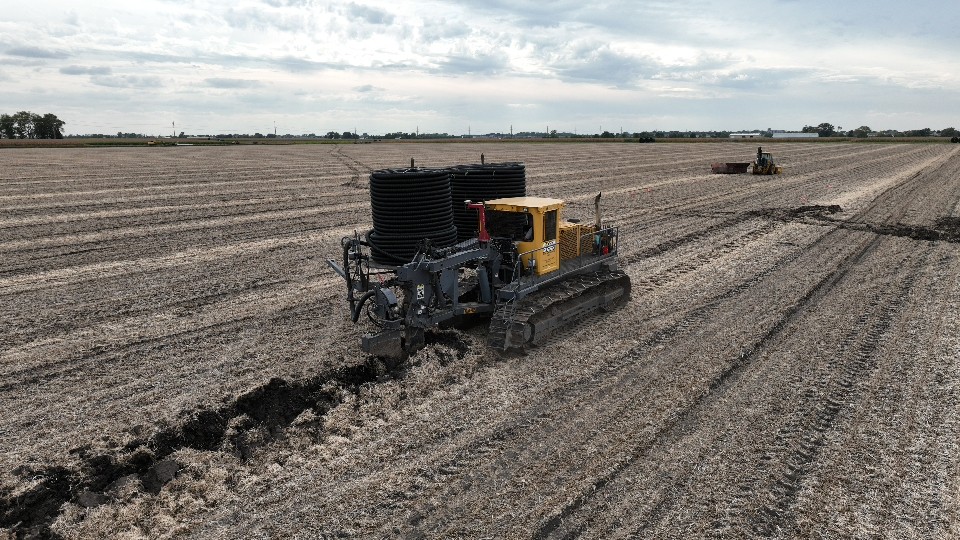
Managing excess water in agricultural fields is vital for maintaining productivity across the U.S. Corn Belt, where subsurface tile drainage systems cover approximately one-third of cropland. Heavy rainfall and waterlogging during critical crop growth stages reduce soil oxygen, suppress root function, and limit crop transpiration, potentially reducing crop yields. To meet growing demand for U.S. bioenergy feedstocks and support the commercial production of fuels, chemicals, and products, improved agricultural water management can help strengthen the production side of domestic supply chains.
In a new study, researchers enhanced the open-source PFLOTRAN model by integrating a dynamic evapotranspiration (ET) module. Using 3D high-resolution modeling, calibrated with field data from Iowa, the team evaluated how varying subsurface tile installation depths and pipe spacings influence field-scale water budget components and crop water use, establishing a site-adaptable digital twin framework to optimize drainage design.
Key Breakthroughs for U.S. Feedstocks
- Tile Depth Controls Crop Water Use: At the Iowa study site, simulated tile drainage reduced waterlogging and increased evapotranspiration compared with undrained conditions. Shallower drains removed less water and reduced simulated evapotranspiration.
- Pipe Spacing Plays a Secondary Role: Tile spacing had less influence on simulated evapotranspiration than installation depth. At the Iowa study site, wider spacing at a drain depth of 1.2 m could lower installation costs with little change in simulated evapotranspiration under the conditions tested.
- Integrated Framework Optimizes Field Design: Combining simulated evapotranspiration with estimated installation costs yields a practical design framework. The framework helps growers compare how well different designs manage excess water and what they cost to install.
By delivering high-resolution digital simulations of field hydrology, this research provides data-driven tools to evaluate tile drainage networks. The framework could help growers manage excess water in Midwestern agricultural landscapes, supporting the farms that supply feedstocks for commercial fuels and chemicals.
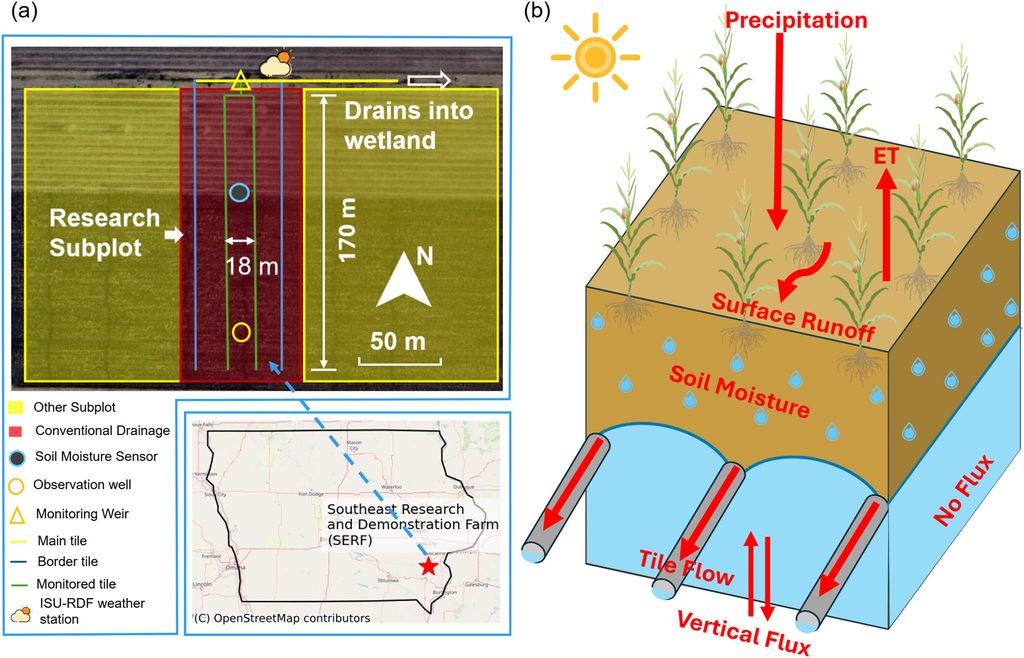
Study Details & Metadata
- Article Title: Three-Dimensional Simulation of Tile Drainage System for Farmland: Quantifying Tile Drainage Impacts on Hydrological Cycle
- Journal: Water Resources Research
- DOI: 10.1029/2025WR042164
- Funding & Support: This work was supported by the Center for Advanced Bioenergy and Bioproducts Innovation (CABBI), a Bioenergy Research Center funded by the U.S. Department of Energy (DOE). It is published as an open-access article.
- Lead Principal Investigator: Kaiyu Guan – kaiyug@illinois.edu
AI Acknowledgement: This summary was prepared with the assistance of an AI collaborator.
Related Publication