Expanding domestic bioenergy production relies on establishing robust, market-driven supply chains for agricultural biomass. However, growing commercial demand for plant-based feedstocks creates competing land-use incentives. As demand for bio-based fuels and products scales, farmers may expand corn acreage or harvest crop residues like corn stover, risking higher nitrate runoff that threatens vital U.S. waterways and municipal drinking water supplies.
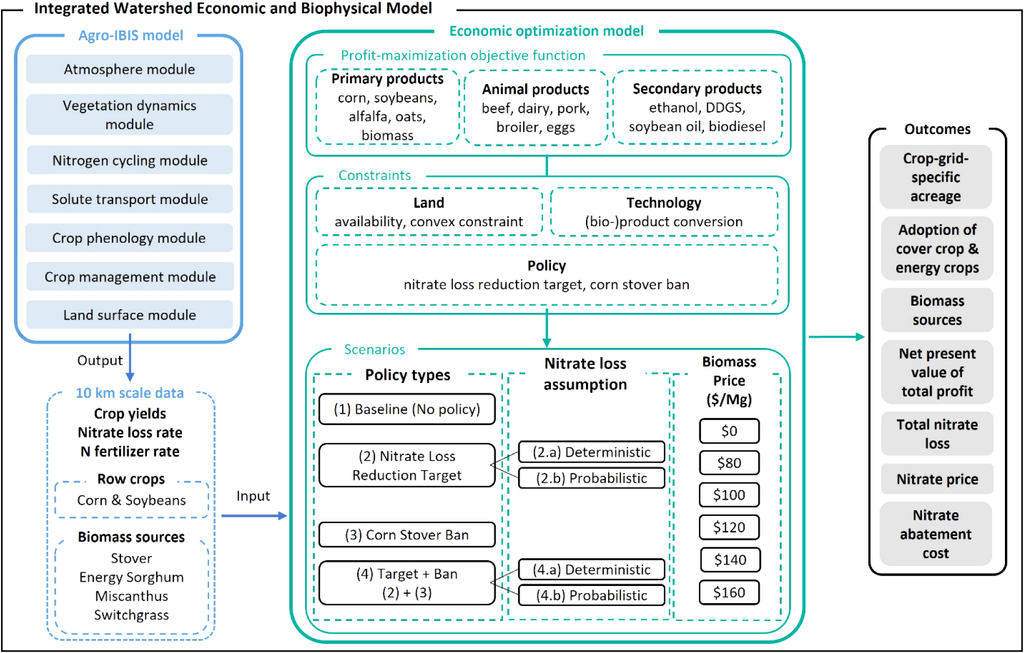
To address this challenge, a new study reports an integrated economic and biophysical model to evaluate how biomass markets and environmental policies interact. Focusing on Iowa’s Raccoon River Basin, the team analyzed how combining biomass market payments with water quality incentives, such as nitrate pricing and stover harvesting restrictions, can cost-effectively scale up domestic feedstocks, while protecting regional water systems.
Key Breakthroughs for U.S. Feedstock Crops
- Unregulated Biomass Markets Risk Increased Runoff: Low-to-moderate biomass prices primarily drive corn stover harvesting rather than perennial crop production. This incentivizes farmers to expand nitrogen-intensive continuous corn systems, increasing regional nitrate loss.
- Integrated Policies Drive Cost-Effective Bioenergy Growth: Achieving state-mandated 41% nitrate loss reduction targets cost-effectively requires integrating winter rye cover crops and high-yielding perennial feedstock crops like miscanthus and energy sorghum, particularly in high-leaching southern watershed zones. Pairing market payments with a targeted nitrate price induces the adoption of these crops, while meeting water quality targets without banning residue harvest.
- Accounting for Uncertainty Strengthens Supply Chains: Incorporating weather variability into land-use models reveals that achieving nitrate reduction targets with high certainty requires greater adoption of perennial feedstock crops due to their deep, stable root systems. Miscanthus and sorghum deliver stable, low nitrate loss rates under weather-related uncertainty, whereas switchgrass remains cost-ineffective at current market prices.
By pairing market incentives for feedstock crops with targeted nutrient management policies, the U.S. can secure reliable supplies of domestic biomass, while protecting critical water infrastructure and natural resources. This study provides a blueprint for policymakers and industry leaders for aligning agricultural biomass production with regional water quality goals, which is essential for building a resilient domestic bioeconomy.
Study Details & Metadata
- Article Title: Unintended Consequences of Biomass Markets and Implications for Nitrate Reduction Policy
- Journal: Environmental Science & Technology
- DOI: 10.1021/acs.est.6c05400
- Funding & Support: This work was supported by the Center for Advanced Bioenergy and Bioproducts Innovation (CABBI), a Bioenergy Research Center funded by the U.S. Department of Energy (DOE).
- Principal Investigator Contact: Madhu Khanna – khanna1@illinois.edu
AI Acknowledgement: This summary was prepared with the assistance of an AI collaborator.
Related Publication
Unintended Consequences of Biomass Markets and Implications for Nitrate Reduction Policy