
Expanding the U.S. bioeconomy requires strategic infrastructure decisions that can seamlessly integrate large-scale fuel refineries with smaller chemical production facilities. While operational variables can adapt over time, facility locations are largely permanent once capital is deployed. Historically, industry planners and policymakers evaluate these facilities independently using uniform scale assumptions or simplified circular collection zones, leaving supply chains vulnerable to land competition and inefficient logistics.
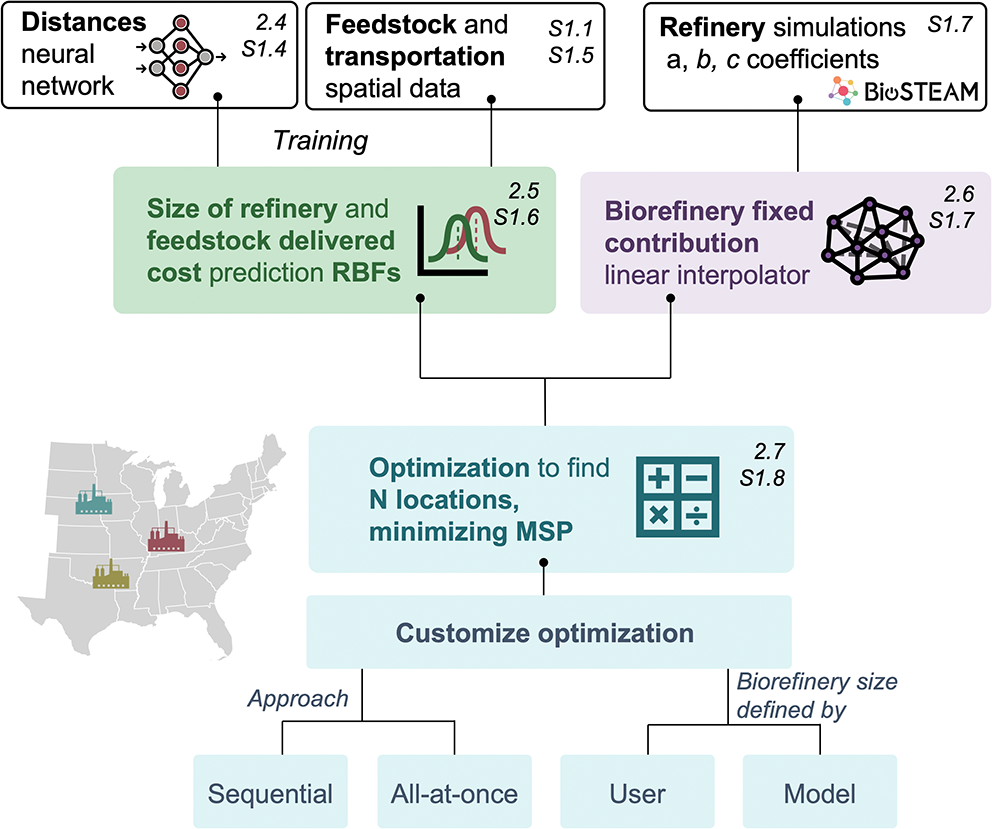
A new study reports the development of an open-source spatial optimization framework that integrates techno-economic analysis with advanced logistics modeling and refinery cost surrogates. Using this model, the researchers evaluate the coordinated deployment of multiscale biorefineries across the U.S. rainfed region. This approach examines how facilities of vastly different capacities—ranging from large cellulosic ethanol and acrylic acid plants to smaller specialty bioproduct units—can share regional agricultural landscapes to advance domestic energy and product manufacturing.
Key Breakthroughs for Domestic Biomanufacturing Infrastructure
- Scale Asymmetry Grants Siting Flexibility: Large fuel refineries anchor regional biomass supply chains and require extensive acreage, whereas smaller-scale biochemical facilities operate with much smaller footprints, retaining high spatial flexibility and easily integrating even when large refineries are already established.
- Decoupling Economic and Spatial Sensitivity: While increasing feedstock planting density from 2% to 10% significantly reduces transportation distances and expands siting options, it yields only modest reductions in minimum selling prices (MSPs), proving that dense local planting is not strictly required for commercial competitiveness.
- Irregular Geometries Expand Feasible Design Spaces: Modeling feedstock collection zones as irregular shapes rather than traditional circles better reflects anisotropic land availability and spatial heterogeneity, preventing optimization bottlenecks and allowing a higher density of facility deployments under constrained resources.
This integrated framework demonstrates that a thriving domestic bioeconomy does not depend on a one-size-fits-all manufacturing model. Instead, coordinating large fuel biorefineries alongside smaller, high value bioproduct plants creates layered, resilient regional networks that maximize land efficiency and secure U.S. manufacturing leadership.
Study Details & Metadata
- Article Title: Spatial Optimization of Multiscale Biorefinery Deployment for a Diversified Bioeconomy in the United States
- Journal: Environmental Science & Technology
- DOI: 10.1021/acs.est.6c07048
- Funding & Support: This work was supported by the Center for Advanced Bioenergy and Bioproducts Innovation (CABBI), a Bioenergy Research Center funded by the U.S. Department of Energy (DOE). It is published as an open-access article.
- Principal Investigator Contact: Jeremy Guest – jsguest@illinois.edu
AI Acknowledgement: This summary was prepared with the assistance of an AI collaborator.