Data for Artificial Neural Networks Estimate Evapotranspiration for Miscanthus × giganteus as Effectively as Empirical Model but with Fewer Inputs
Themes: Sustainability
Keywords: AI/ML, Miscanthus, Modeling
Citation
Aslan-Sungur, G., Moore, C.E., Bernacchi, C.J., Heaton, E., VanLoocke, A. Oct. 21, 2026. “Data for Artificial neural networks estimate evapotranspiration for Miscanthus × giganteus as effectively as empirical model but with fewer inputs.” University of Illinois Urbana-Champaign. DOI: 10.13012/B2IDB-7350566_V1.
Overview
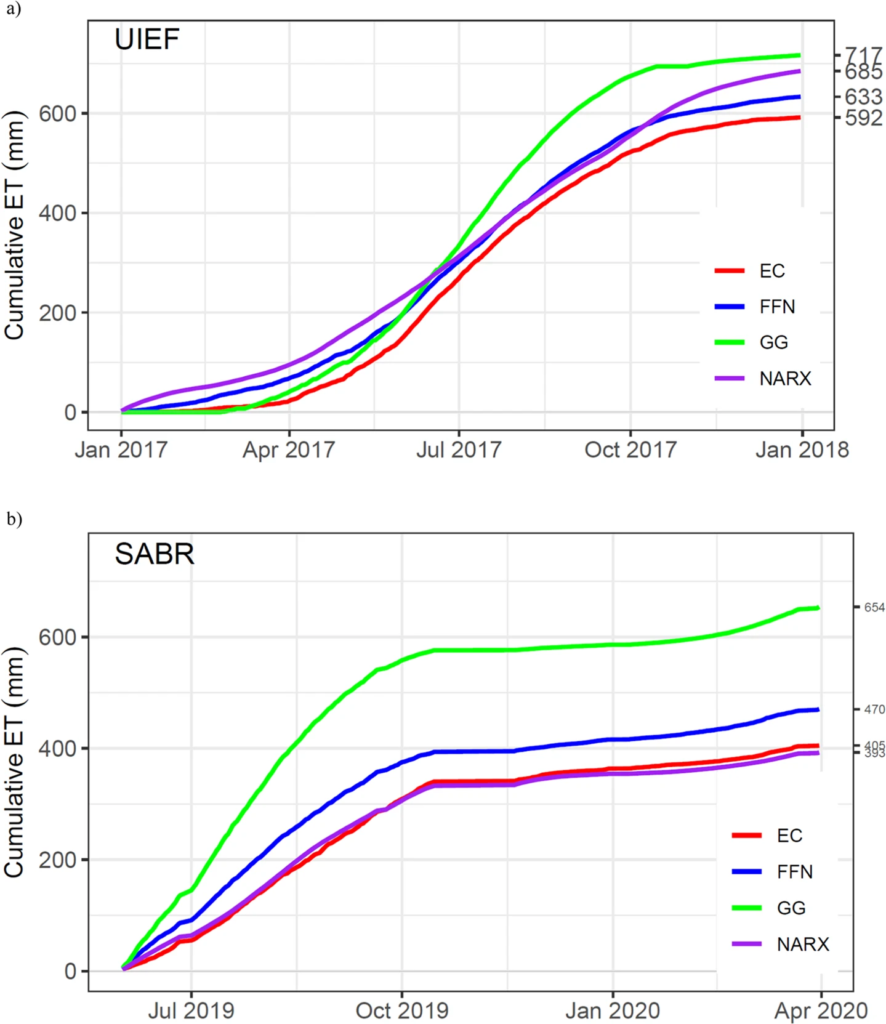
Estimating actual evapotranspiration (ET) is particularly crucial for addressing how vegetation affects the water balance of ecosystems. ET estimation can be complex with empirical models due to their many parameters and reliance on aridity. In contrast, artificial neural networks (ANNs) could potentially estimate ET with fewer and more common meteorological parameters. In this study, we trained two ANNs, one using a feed-forward approach (FFN) and the other a nonlinear auto-regressive network (NARX), to predict ET and compared them to the commonly used empirical model Granger and Gray (GG). We trained our models on a nine-year eddy covariance (EC) dataset for Miscanthus × giganteus (M. × giganteus) from Illinois (UIEF), then tested them using out-of-sample data from both UIEF and a different location in Iowa (SABR) to compare the accuracy of FFN, NARX, and GG models in estimating daily ET. A combination of air temperature (Ta) and solar radiation (Rs) was chosen as inputs due to the highest R2 for FFN (R2 = 0.79, 0.81, and 0.79 for training, testing, and validation, respectively) and only Ta for NARX (R2 = 0.70 for out-of-sample validation). The predictive power of the FFN model was superior to the NARX and GG models at the UIEF site (R2 = 0.84, 0.70, and 0.83 for out-of-sample validation, respectively). Our analysis showed that ANN approaches are as accurate as empirical approaches for estimating ET but use fewer inputs.
Data
AmeriFlux: University of Illinois (UIEF) carbon flux data
AmeriFlux: Iowa State (SABR) carbon flux data
Illinois Data Bank: input variables, comparison of nonlinear auto-regressive network (NARX) and feed-forward neural network (FNN) performance, evapotranspiration prediction performances