Data for Phenotypic Evaluation of Saccharum spp. Genotypes During the Plant-Cane Crop for Biomass Production in Northcentral Mississippi
Themes: Feedstock Production
Keywords: Biomass Analytics, Energycane, Field Data, Phenotyping, Sugarcane, Yield
Citation
Baldwin, B.S., Hale, A.L., Eason, W.A., and Morrison, J.I. Oct. 22, 2026. “Data for Phenotypic Evaluation of Saccharum spp. Genotypes during the Plant-Cane Crop for Biomass Production in Northcentral Mississippi.” University of Illinois Urbana-Champaign. DOI: 10.13012/B2IDB-4486824_V1.
Overview
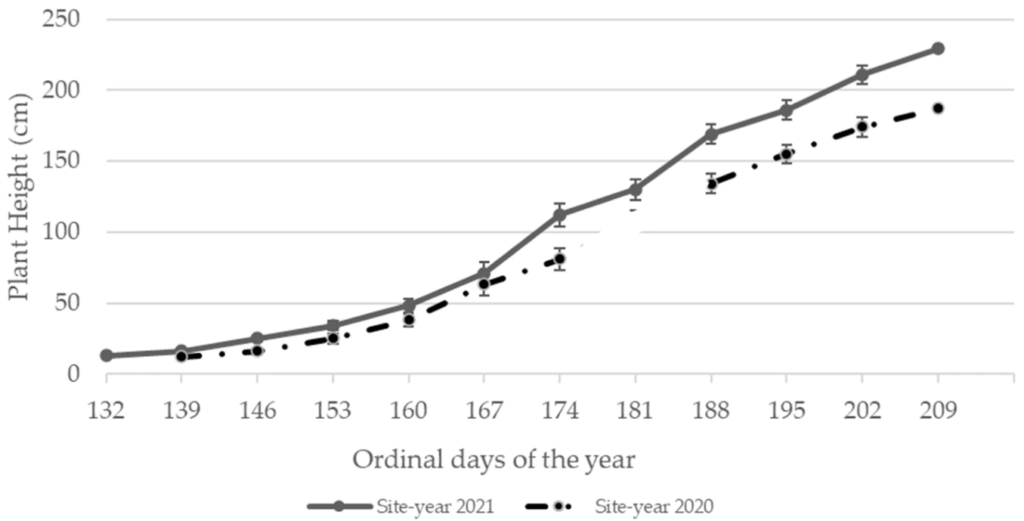
Saccharum is relatively new to 33° N latitude. S. spontaneum readily hybridizes with commercial sugarcane (Saccharum spp.) and lends cold tolerance and greater yield to the hybrid progeny, called energycane. Since 2007, there have been numerous new hybrid and backcross energycane genotypes developed but there is a paucity of information about them. Twenty energycane genotypes were tested in the first season of growth from cane propagules (plant cane; PC) against Ho 02-113 (a control) for two site-years in northcentral Mississippi. Grand (exponential) growth continued into October. The prevailing paradigm is that tonnage is what matters. Except for percentage cellulose, all factors tested (dry matter yield, extractable juice volume, °Brix, theoretical ethanol from fermentation, theoretical ethanol from cellulose, and total theoretical ethanol) were greater from the second site-location compared to the first. Dry matter yield (DMY) and total theoretical ethanol yield (TTEY) were moderately correlated. Over the two years of this test only Ho 14-9213 exceeded in mean DMY of Ho 02-113. Sixteen of the 19 test genotypes in this test equaled or exceeded the mean TTEY of Ho 02-113.
Data
Illinois Data Bank: genotypes, dry matter yields, extracted juice volume, Brix, theoretical ethanol from fermentation of juice (TEF), theoretical ethanol from cellulose (TEC), total mean theoretical ethanol yield (TTEY).