Final Eddy Covariance Dataset to Support Lessons from Long-term Monitoring of Carbon Gains and Losses in Cropping Systems
Themes: Sustainability
Keywords: Carbon, Ecosystem Flux, Ecosystem Science, Yield
Citation
Moore, C.; Bernacchi, C. Sep. 23, 2025. “Final eddy covariance dataset to support lessons from long-term monitoring of carbon gains and losses in cropping systems.” Dryad. Dataset. DOI: 10.5061/dryad.kd51c5bjt
Overview
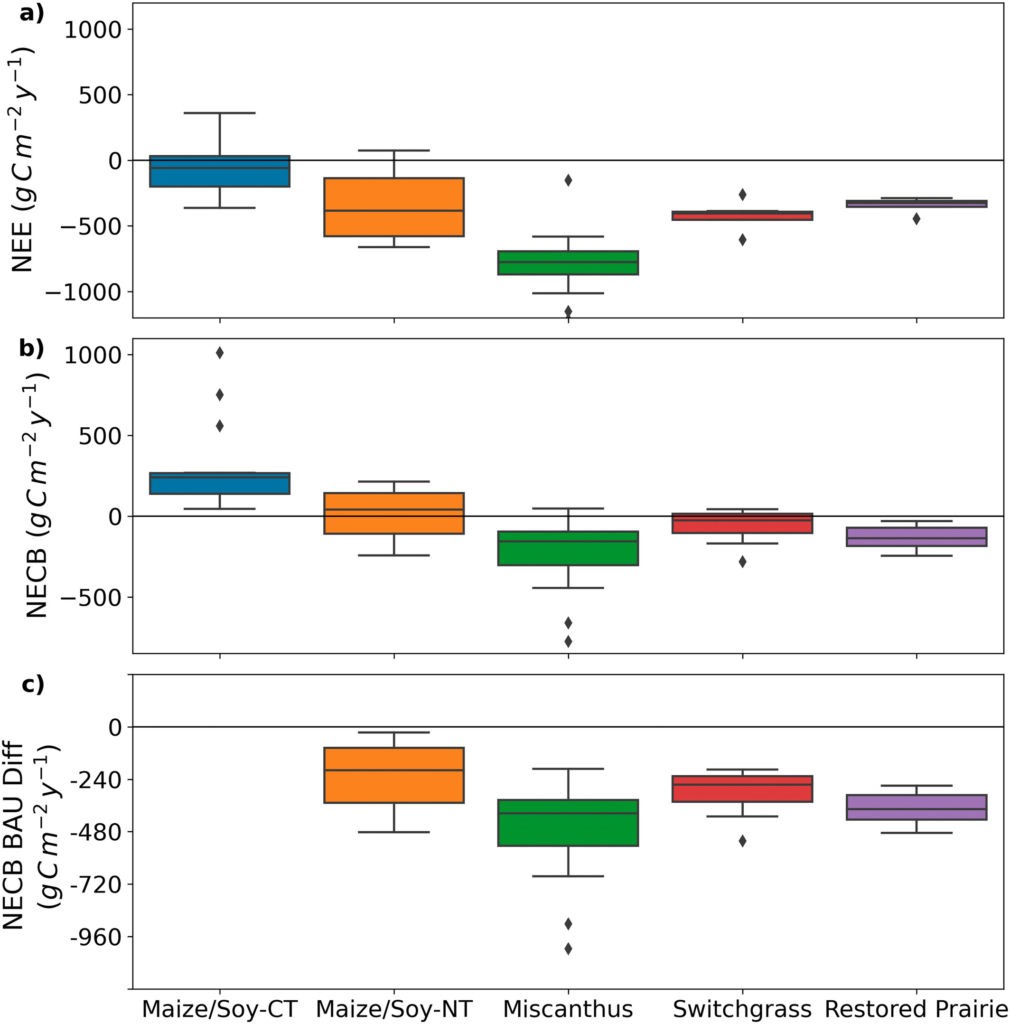
Annual net ecosystem exchange (NEE), yield, and net ecosystem carbon budget (NECB) for different cropping systems in the Midwest US. Values are taken from previously published values that are available from Ameriflux. The datasets specifically used were US-UiA University of Illinois Switchgrass, US-UiB University of Illinois Miscanthus, US-UiC University of Illinois Maize-Soy, US-UiD University of Illinois Restored Native Prairie and US-Bo Bondville. Each dataset was quality assured and gap filled following the same method as outlined in Moore et al., (2020) for all sites. NECB was calculated using annual yield data based on dry mass for each crop and carbon content fraction of 0.48 for biomass harvests (Miscanthus, switchgrass and restored prairie) and 0.45 for grain harvests (maize-soybean systems). CT refers to conventional tillage and NT refers to no-till maize/soy systems. Values below zero represent an annual net uptake of carbon, while values above zero represent an annual net carbon loss from the system. Missing values are denoted as NaN.
Data
Dryad: Net ecosystem exchange, harvest yield, net ecosystem carbon balance