Data for The Productivity of Perennial Crops Miscanthus and Switchgrass is More Resistant to Vapor Pressure Deficit Stress than Maize
Themes: Feedstock Production, Sustainability
Keywords: Ecosystem Flux, Field Data, Miscanthus, Miscanthus × giganteus, Modeling, Perennial Bioenergy Grasses, Switchgrass, Yield
Citation
Benson, M.C., Hartman, T., Pederson, T.L., Yi, K., Heaton, E.A., Bernacchi, C.J. Aug. 7, 2026. Data for “The Productivity of Perennial Crops Miscanthus and Switchgrass is More Resistant to Vapor Pressure Deficit Stress than Maize.” University of Illinois Urbana-Champaign. DOI: 10.13012/B2IDB-7268055_V1.
Overview
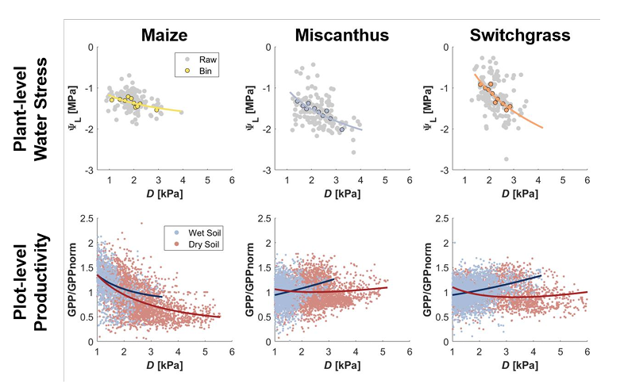
Rising atmospheric vapor pressure deficit (D) with warming is an increasingly important driver of crop productivity loss, yet the relative sensitivity of conventional seed crops and alternative perennial crops remains poorly resolved. In this study, we combined a 9-year eddy covariance carbon flux record (2008 – 2016) with 600+ midday leaf water potential ( ψ L ) measurements (2024 – 2025) from adjacent maize (Zea mays), miscanthus (Miscanthus x giganteus), and switchgrass (Panicum virgatum) plots to: (1) quantify the limitations of elevated D on crop-specific productivity and (2) evaluate how these responses vary as a function of soil moisture (Θ) status. We found that maize strictly regulated ψ L and its gross primary productivity (GPP) was strongly reduced by increasing D. In contrast, miscanthus and switchgrass allowed larger ψ L declines and sustained higher GPP under similar moisture constraints. D exerted a larger limitation on maize GPP than Θ, but D-driven declines were less severe when accompanied by high Θ. GPP sensitivity to D was also influenced by Θ for miscanthus and switchgrass, but the buffering effect was stronger compared to maize. Specifically, high D paired with high Θ were the most productive conditions for the perennials, reflecting temperature-driven gains in photosynthetic efficiency when evaporative stress was mitigated by sufficient soil water supply. Overall, miscanthus and switchgrass displayed greater resistance to atmospheric drought and more stable GPP across hydroclimate variability than maize. These findings highlight that maize is more vulnerable to future projections of rising D than miscanthus or switchgrass.
Data
Illinois Data Bank: Figure data, eddy covariance flux tower instrumentation, model coefficient estimates