Data for Physiological Controls on Carbon Fluxes and Biomass Production in Miscanthus: Insights From a Process-Based Agroecosystem Model
Themes: Feedstock Production, Sustainability
Keywords: Carbon, Ecosystem Flux, Miscanthus, Modeling
Citation
Jiang, Z., Guan, K., Li, Z., Grant, R., Qin, R., Hartman, T., Jia, M., Zhang, J., Peng, B., Heaton, E., VanLoocke, A., Bernacchi, C., Leakey, A.D.B., Zhou, L. July 2, 2026. Data for: “Physiological Controls on Carbon Fluxes and Biomass Production in Miscanthus: Insights From a Process-Based Agroecosystem Model”. University of Illinois Urbana-Champaign. DOI: 10.13012/B2IDB-3267752_V1.
Overview
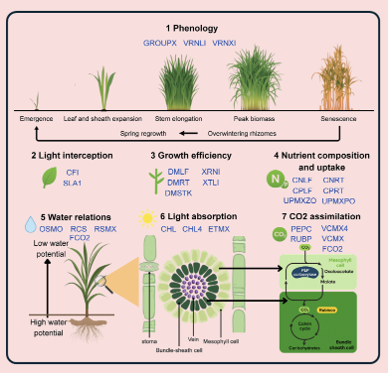
Biomass crops serve as essential feedstocks for renewable energy and bioproducts and play a critical role in achieving lower emissions in the transportation sector. However, dedicated perennial biomass crops such as Miscanthus × giganteus (Miscanthus) remain underrepresented in process- based agroecosystem models, limiting robust evaluation of their economic and environmental performance. In this study, we developed a data- constrained representation of the sterile triploid Miscanthus (IL clone) within the process-based model ecosys, integrating global sensitivity analysis, ensemble simulation, and parameter calibration. Planting, harvesting, and fertilization practices consistent with field management were incorporated, and phenology was constrained using PhenoCam- derived Green Chromatic Coordinate (GCC) data. Using the Morris global sensitivity analysis method, we identified 11 key physiological parameters governing plant carbon, water, and nutrient relations, particularly processes associated with CO2 assimilation. We then conducted ensemble simulations by perturbing these parameters and calibrated the model against eddy covariance fluxes and field- measured biomass. Building on the calibrated operating state, parameter- response analyses show that different photosynthetic processes influence productivity in different ways. Protein allocation determines whether productivity increases toward a higher level, whereas electron transport capacity controls additional gains once protein allocation approaches saturation. These findings demonstrate that parameter importance depends on physiological context and on which photosynthetic processes remain limiting. Calibration and validation against observations show that ecosys can reliably reproduce carbon and water fluxes, as well as both above- and belowground biomass, with post- calibration GPP R2 improving from 0.67 to 0.95 during the calibration period and remaining high during validation (R2 = 0.95). These results provide a mechanistic foundation for regional simulations and sustainable bioenergy assessments.
Data
Illinois Data Bank: Model/management parameters
GitHub: ECOSYS model code
FluxNet: Flux data
Illinois Data Bank: Biomass data
ORNL: PhenoCam dataset