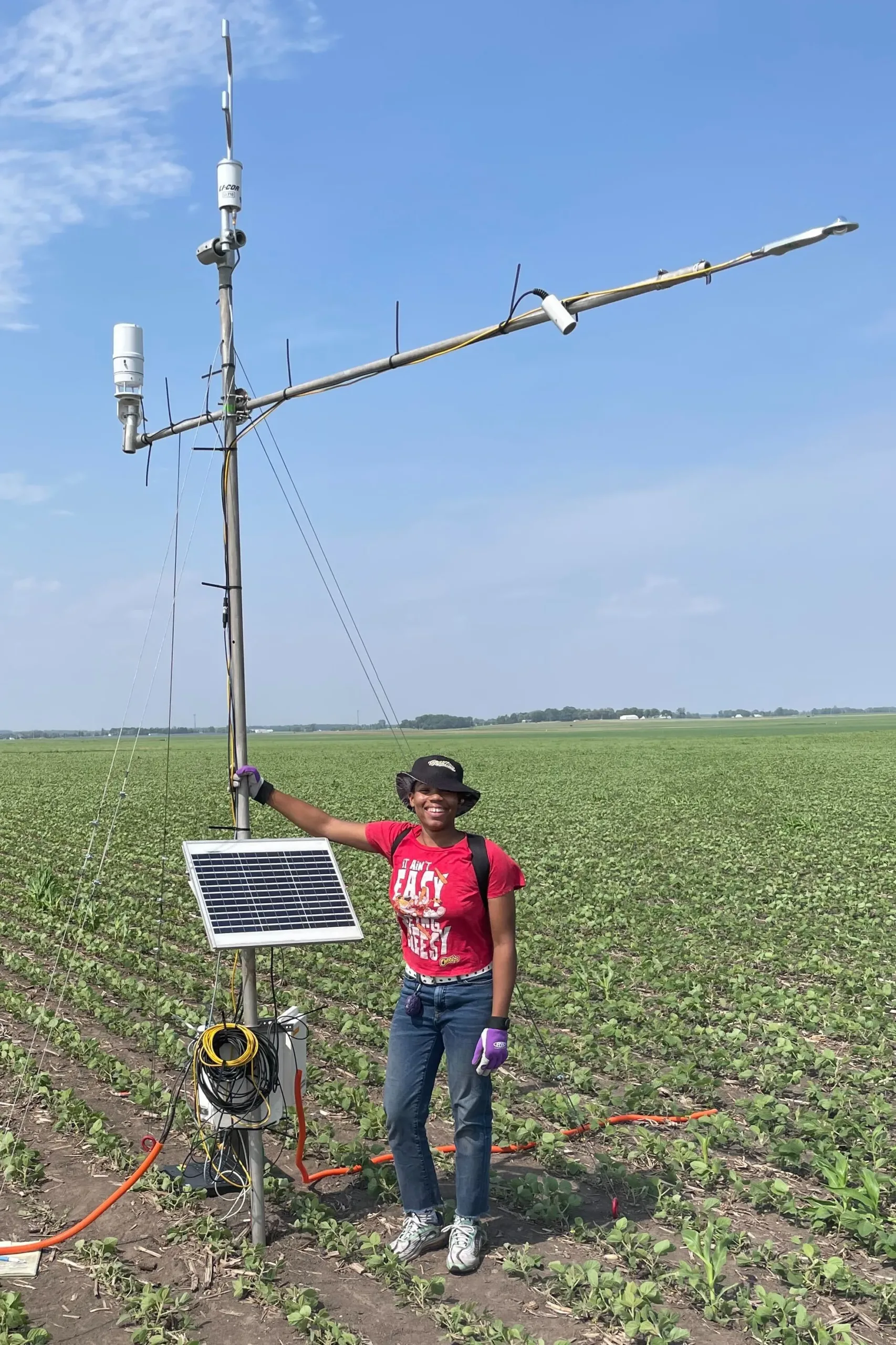
Tiptoeing between rows of soybean plants, Sanai Brown and her mentor, Michael Benson, carry a variety of scientific instruments and equipment out to the middle of a farm field in Champaign County. Their goal for the day is to set up a surface energy balance tower that will collect data about the heat fluxes to and from the field.
For Benson, a postdoctoral researcher in the Carl Bernacchi lab group, this is a familiar task, but for Brown, it’s an entirely new experience in the world of research.
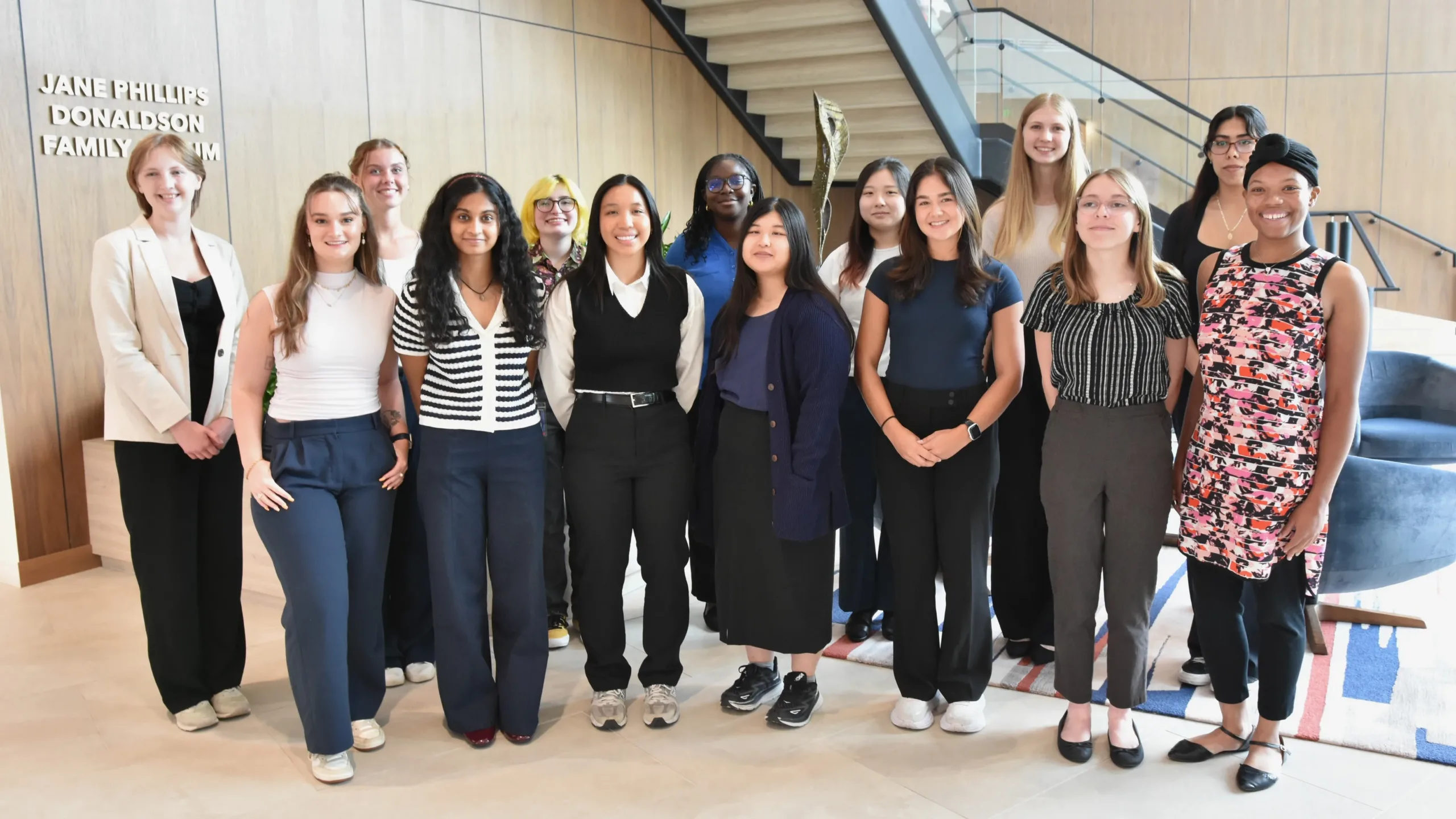
A junior majoring in Environmental Studies and Agronomy at Florida A&M University, Brown is one of 19 student interns who participated in the annual Research Internship in Sustainable Bioenergy (RISE) in summer 2025. RISE is supported by the Department of Energy through the Center for Advanced Bioenergy and Bioproducts Innovation (CABBI), the National Science Foundation, and Boeing. This program aims to strengthen the bioenergy talent pipeline, offering research and career development opportunities for promising undergraduates.
During this 10-week paid internship program, students were paired with a CABBI mentor and worked on a research project. They gained experience in plant biology, agronomy, synthetic biology, genetics, environmental sciences, chemical engineering, and civil & environmental engineering. In addition to their research projects, students also participated in a series of seminars on STEM career options, graduate school, the research process, and science communication.
The 2025 interns came from across the country and worked at eight CABBI sites: the University of Illinois Urbana-Champaign, University of Wisconsin-Madison, Princeton University, Lawrence Livermore National Laboratory, Lawrence Berkeley National Laboratory, Pennsylvania State University, Iowa State University, and HudsonAlpha Institute for Biotechnology. Each received a $6,000 stipend, and housing and travel were provided.
For Brown, RISE was an opportunity to see firsthand what a career in research looks like. Although she had some basic lab experience prior to RISE, this was the first time Brown played a significant role in a research project. “I was more of an assistant than anything else,” she said. “But with RISE, I feel more like a scientist.”
In total, Brown and Benson installed surface energy balance towers in six commercial soybean fields across Champaign County. Three of these fields are tilled, while the other three are not. Brown’s research project investigated how tillage practices affect the surface energy balance of these fields.
The installation of these towers was just the beginning of Brown’s work. In the weeks that followed, she became an expert on quality assurance and quality control measures – procedures done to ensure that there are no issues with the data collected out in the field – and data analysis.
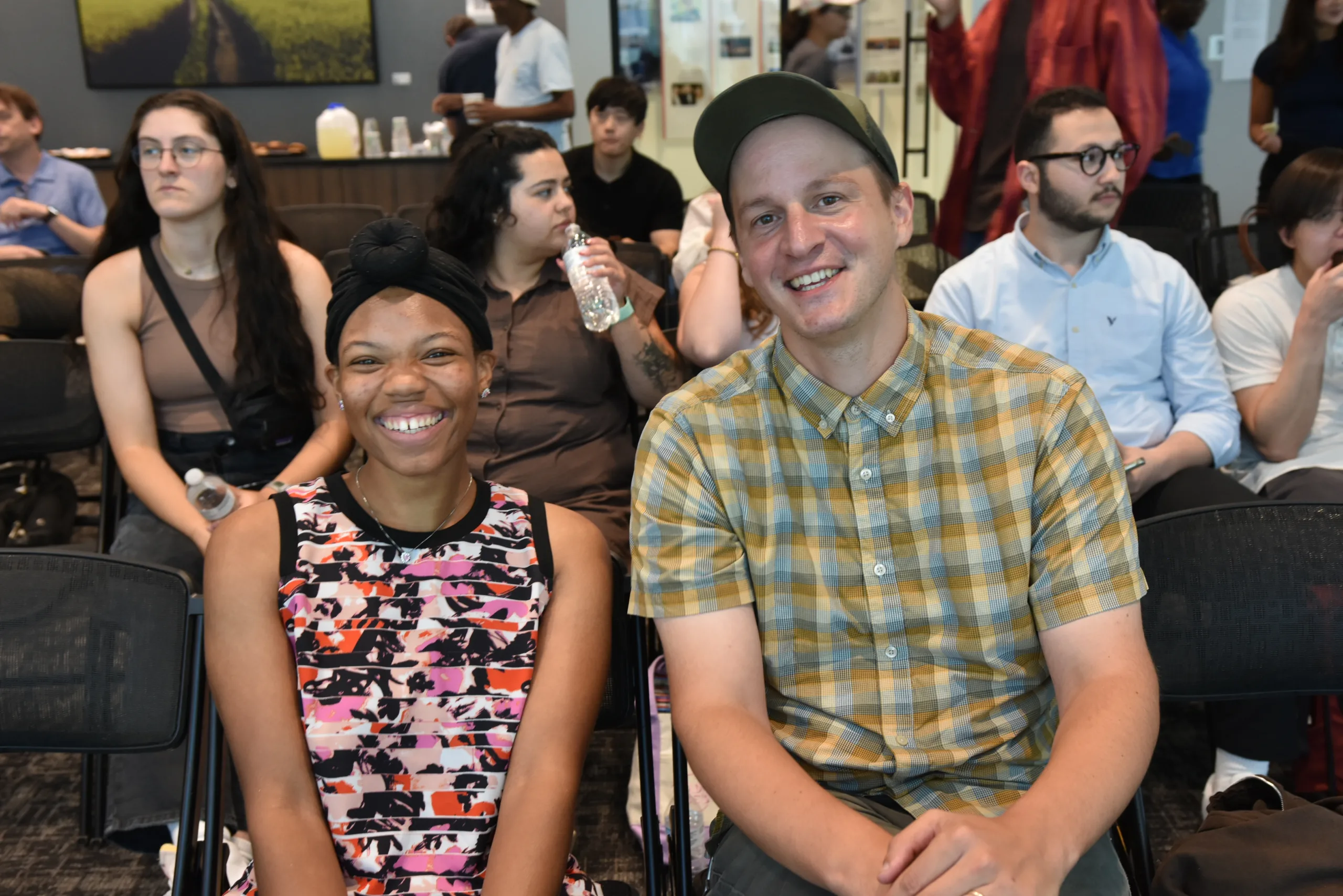
Near the end of the summer, all the RISE interns came together for the 2025 CABBI annual retreat, where they networked with 280+ colleagues from across CABBI’s three themes, attended research panels, and presented their research at the RISE symposium. For many of the students, this was their first time giving a formal talk about their research.
“One of the great things about this program is that there’s a lot of emphasis on how to effectively give a scientific presentation,” Benson said.
Brown agreed, citing the presentation workshop she attended through RISE as an eye-opening learning opportunity. “My research talk took a lot of preparation, and there was a lot of trial and error, but I learned so much from the workshop and conversations with Michael,” she said. “And all that information will stick with me into the future. I’m glad I got to have this experience.”
The experiences they’ve had and connections they’ve made, both in and out of the lab, will provide these students with a strong foundation for future research endeavors and networking.
“I’m looking forward to building more connections such as the ones I made during this program,” Brown said. “And I have a great mentor cheering me on. I know I can reach out to him for advice.”
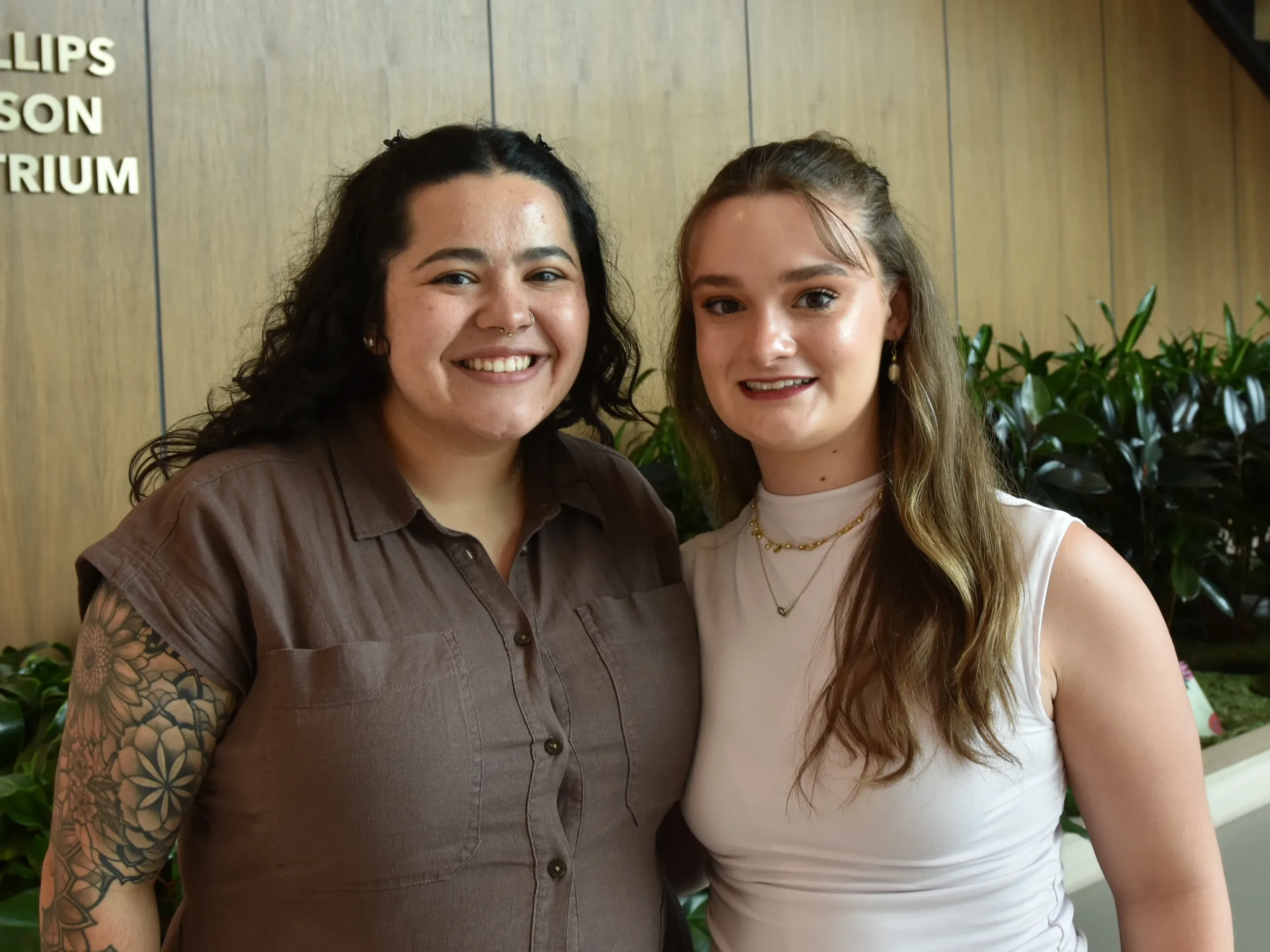
Fellow RISE intern Lily Williams had similar sentiments.
Williams spent her summer studying how the expression of NAD+-dependent genes changes over time in the yeast Rhodotorula toruloides. NAD+ is an essential coenzyme in many biological processes but is known to decline with age. As R. toruloides cells age, their bioproduct output does not remain consistent, so her project aims to shed light on why that is.
Williams is a senior at Pennsylvania State University studying Biochemistry and Molecular Biology. She works in the Melanie McReynolds lab group during the school year, and RISE presented her with the opportunity to continue her work over the summer.
“It’s a very exciting project,” Williams said. “Because this species of yeast we’re working with is so understudied, it’s all brand new, both to us and to the field. But that can be a challenge, too. I had to design and validate all the primers we worked with, for example.”
For Alexandria Murphy, a fourth-year Ph.D. student in the McReynolds lab and Williams’ mentor, the most rewarding part of being a RISE mentor is seeing her mentees develop confidence in themselves as researchers.
“I give advice and we talk through questions, but Lily’s presentation was all her own,” Murphy said. “I get to help her become the best version of the scientist she can be. That’s the best part.”
In the future, Williams hopes to attend graduate school, earn her Ph.D., and eventually become a principal investigator.
“Having a great mentor like Alexandria has really confirmed for me that this is what I want to do,” she said. “I want to teach others the way that I’ve been taught and give them the opportunities this mentorship has given me.”
For additional details, research project descriptions, and applications, visit CABBI’s RISE page.
The application deadline for RISE 2026 is fast approaching! Apply by Feb. 15, 2026.
— Article by CABBI Communications Specialist April Wendling