Data for The Value of Reversible Carbon Storage in a Zero-Emissions World
Themes: Sustainability
Keywords: Carbon
Citation
Mayer, A.C., Dumortier, J., Hausfather, Z., Pett-Ridge, J., Slessarev, E.W. June 7, 2026. Data for: “The Value of Reversible Carbon Storage in a Zero-Emissions World.” University of Illinois Urbana-Champaign. DOI: 10.13012/B2IDB-0788303_V1.
Overview
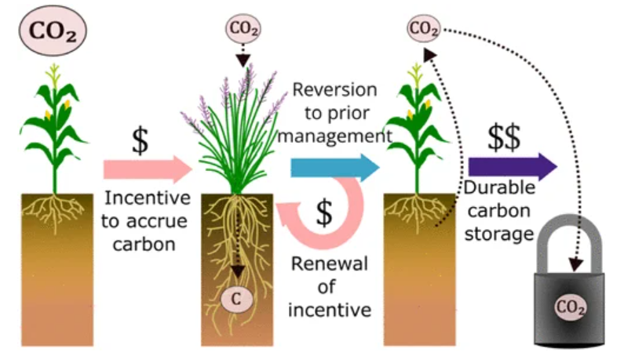 Atmospheric carbon dioxide removal (CDR) is required to stabilize global temperature. CDR can be achieved via ecosystem-based approaches that are cost-effective but reversible (e.g., soil and forest management) or by more durable but expensive approaches (e.g., direct air capture coupled with geologic storage). Here, we examine trade-offs between these approaches, focusing on timing, climate impacts, and cost. We simulated reversible carbon accrual for a range of CDR contract structures using a general minimalist model of ecosystem carbon cycling, and parameterized it to simulate US agricultural soil management─specifically cover cropping─as a case study. We then quantified the resulting impact on atmospheric carbon and global temperature using a climate model emulator. We find that maintaining a patchwork of reversible CDR projects by replacing lapsed projects with new projects can reduce warming by 22–195 μ°C in 2100 and that the magnitude of this cooling effect depends on how effectively the patchwork is maintained. Long-term maintenance of reversible CDR projects requires institutional stability that cannot be guaranteed over multiple decades. Consequently, effective CDR ultimately requires replacing reversible projects with durable projects. To address this problem, we modeled the cost of replacing reversible agricultural soil CDR with geologic CDR. We found that using reversible CDR as a bridge to durable CDR is potentially more cost-effective as a global cooling strategy (0.20–0.81 billion USD per μ°C avoided) than perpetual maintenance of reversible CDR (0.32–1.31 billion USD per μ°C avoided) or an immediate transition to durable CDR (1.37–2.19 billion USD per μ°C avoided). However, we emphasize that institutional commitments to maintain reversible CDR projects cannot be guaranteed. Reliance on reversible CDR as a bridge to durable CDR therefore carries an unknown amount of risk and will only function if efforts to maintain reversible CDR are robust.
Data
Illinois Data Bank: Global temperature reductions, experiment datasets
FigShare: R code, experiment datasets