Data for Environmental Factors Have a Greater Influence on Photosynthetic Capacity in C4 Plants than Biochemical Subtypes or Growth Forms
Themes: Feedstock Production
Keywords: Modeling, Photosynthesis, Sorghum
Citation
Fan, Y., Noble, D.W.A., Medlyn, B.E., Monson, R.K., Sage, R.F., Smith, N.G., Ainsworth, E.A., Busch, F.A., Danila, F.R., Ermakova, M., Friesen, P., Furbank, R.T., Gan, S.H., Ghannoum, O., Griffith, D.M., Gu, L. Jacob, V., Knauer, J., Leakey, A.D.B., Li, S., Lombardozzi, D.L., Ludwig, M., Pathare, V.S., Peixoto, M.M., Prado, K., Sonawane, B.V., Still, C.J., von Caemmerer, S., Woodford, R., Way, D.A. Aug. 31, 2025. Data for: “Environmental Factors Have a Greater Influence on Photosynthetic Capacity in C4 Plants than Biochemical Subtypes or Growth Forms.” GitHub Repository.
Overview
Our understanding of how photosynthetic capacity varies among C4 species and across growth and measurement conditions remains limited.
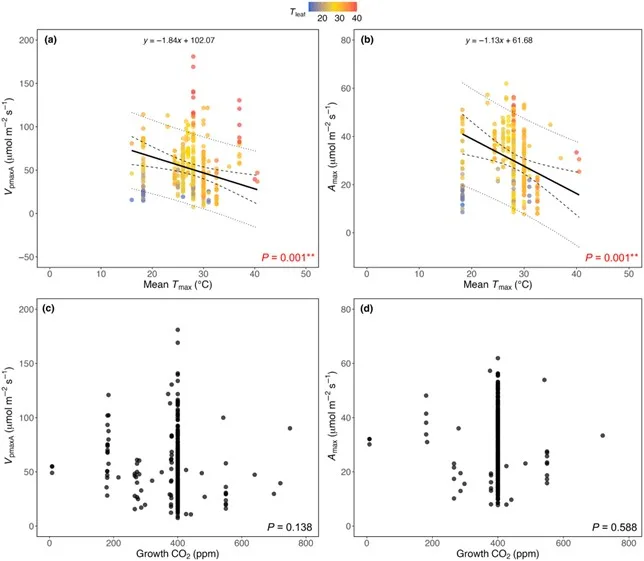
We collated 1696 CO2 response curves of net CO2 assimilation rate (A/Ci curves) from C4 species grown and measured at various environmental conditions and used these data to estimate the apparent maximum carboxylation activity of phosphoenolpyruvate carboxylase (VpmaxA) and CO2-saturated net photosynthetic rate (Amax), two key parameters describing photosynthetic capacity. We examined how VpmaxA and Amax vary with species-specific traits, growth and measurement conditions.
We found little systematic variation of VpmaxA and Amax across the classical C4 biochemical subtypes or growth forms, but showed that growth temperature and measurement conditions are major factors determining C4 photosynthetic capacity. We found no evidence that common C4 model species (e.g. maize, sorghum and Setaria viridis) differ in photosynthetic capacity from other C4 species when grown in controlled environments. However, C4 model species showed up to twice the photosynthetic capacity of other C4 species when grown in the field.
Our multivariate model accounts for 47–51% of the variation reported in VpmaxA and Amax, and we argue that environmental conditions have a greater influence on C4 photosynthetic capacity than biochemical subtypes or growth forms.
Data
GitHub: Supplementary datasets containing C4 A/Ci data collated for this study and estimated apparent VpmaxA and Amax used in the analysis.