Data for Expression of a Bacterial Trehalose 6-Phosphate Synthase Gene otsA in Camelina sativa Seeds Promotes the Channelling of Carbon Towards Oil Accumulation
Themes: Feedstock Production
Keywords: Lipids, Metabolic Engineering, Vegetative Oils
Citation
Sah, S.K., Zhai, Z., Shi, H., Chai, J., Deng, E., Schwender, J., Yu, X., Shanklin, J. Dec. 19, 2025. “Expression of a Bacterial Trehalose-6-phosphate Synthase Gene otsA in Camelina sativa Seeds Promotes the Channeling of Carbon Towards Oil Accumulation.” University of Illinois Urbana-Champaign. DOI: 10.13012/B2IDB-0728043_V1.
Overview
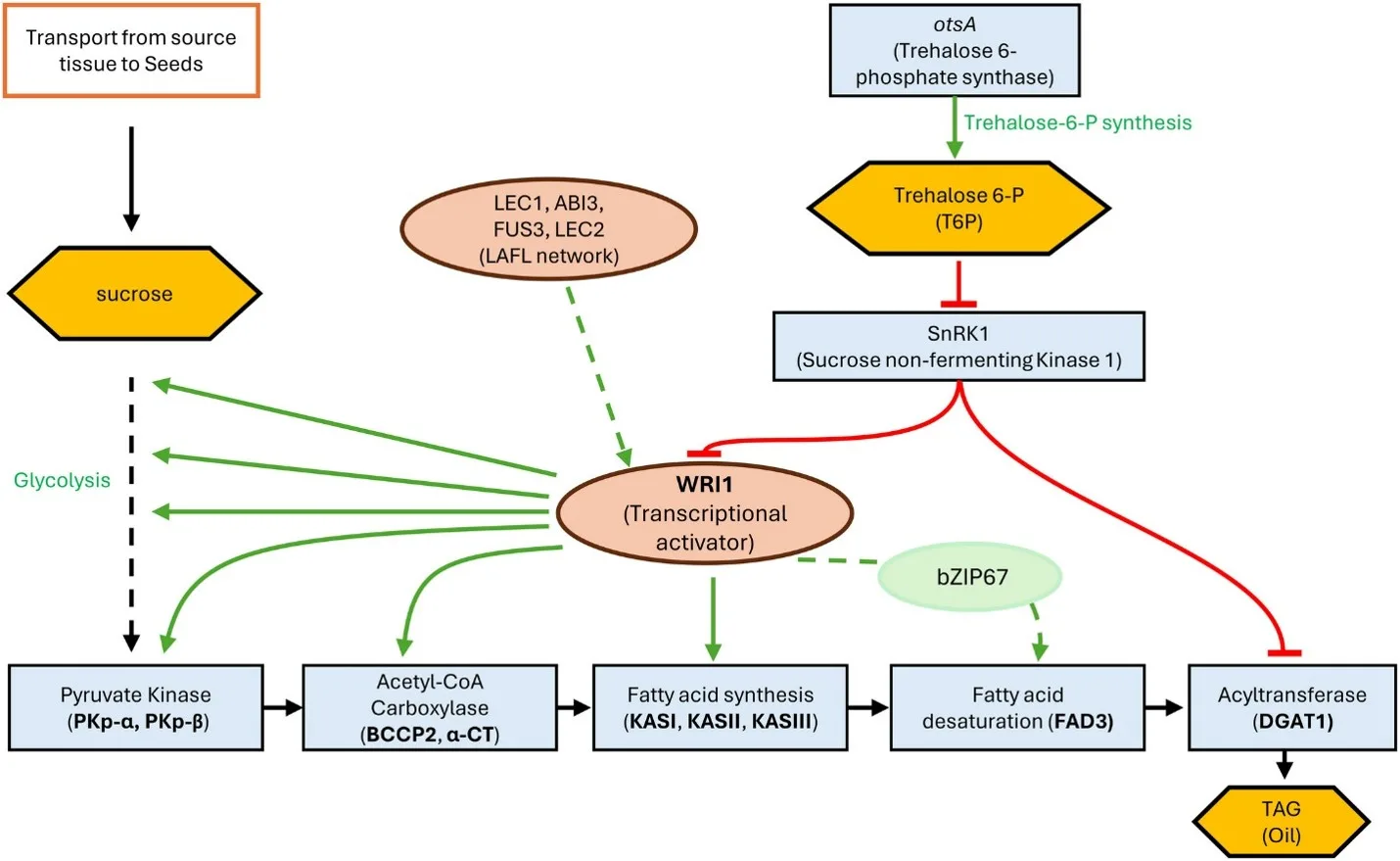
Improving seed oil yield is essential for developing Camelina sativa as a sustainable biofuel crop. Fatty acid synthesis depends on the production of acetyl-CoA from photosynthetically derived sugars. Trehalose 6-phosphate (T6P), a proxy for sucrose availability, can link sugar status to plant growth and development. Synthesised by trehalose 6-phosphate synthase (TPS) from UDP-glucose and glucose-6-phosphate, T6P plays a regulatory role in metabolism. Our previous studies on Arabidopsis transgenic lines constitutively expressing the E. coli otsA (encoding TPS) showed increased T6P levels and seed triacylglycerol, along with stunted growth. In the present study we express otsA in camelina under the control of a seed-specific Phaseolin promoter. Seeds of the resulting transgenic lines accumulated high levels of T6P, and a 15%–20% increase in total fatty acids and triacylglycerol compared to wild-type. Molecular analysis showed the transgenic seeds had reduced SnRK1 activity, elevated WRI1 protein levels, and increased the levels of WRI1 and its target genes, along with enhanced rates of fatty acid synthesis that increased seed weights relative to wild type. Notably, the increase in oil did not affect seed protein levels but did reduce the soluble metabolite fraction. Crucially, seed-specific expression of otsA mitigated the growth defects associated with constitutive otsA expression, and the transgenic lines showed normal seed development and germination. These findings demonstrate that targeted T6P modulation via seed-specific otsA expression is an effective metabolic engineering strategy to boost oil production in camelina and potentially in other oilseed crops and bioenergy crops such as energycane, sorghum and miscanthus.
Data
Illinois Data Bank: TAG/TFA (dry weight, composition profiles), biomass metabolites/lipids/protein, seed weight/size, additional field data