Data for High Yield Production of 3-Hydroxypropionic Acid Using Issatchenkia orientalis
Themes: Conversion, Sustainability
Keywords: Bioproducts, Biorefinery, Metabolic Engineering, Technoeconomic Analysis
Citation
Tan, S.I., Bhagwat, S.S., Martin, T.A., Suthers, P.S., Tran, V.G., Tang, W., Fatma, Z., Maranas, C., Guest, J.S., Zhao, H. Jan. 9, 2026. Data for “High Yield Production of 3-hydroxypropionic Acid using Issatchenkia orientalis.” GitHub.
Overview
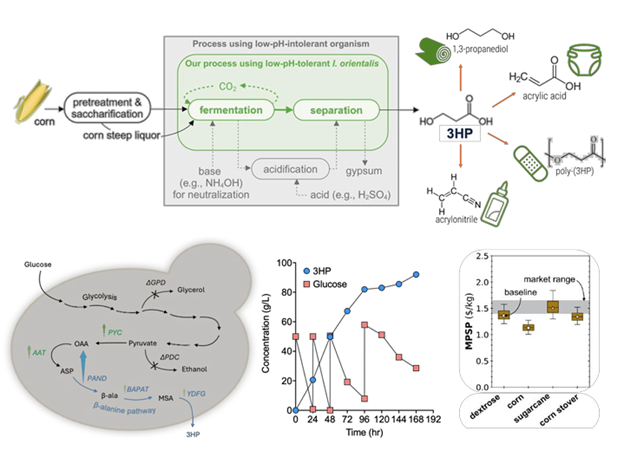
This module contains biorefinery configurations for the production of acrylic acid and sodium 3-hydroxypropionate (3-HP salt) via biologically produced 3-hydroxypropionic acid (3-HP) using dextrose monohydrate, corn, sugarcane, or corn stover as a feedstock as discussed in [1] and [2].
Biomanufacturing provides a more sustainable alternative to fossil-based chemical manufacturing. 3-Hydroxypropionic acid (3HP) is a top Department of Energy value-added chemical and precursor to bioplastics, yet cost-effective microbial production remains elusive. Here, we establish the acid-tolerant yeast Issatchenkia orientalis as a robust host for low-pH 3HP biosynthesis. Genome-scale modeling identifies the β-alanine pathway as optimal, offering the highest theoretical yield and lowest oxygen requirement. Thermodynamic analysis confirms its favorability under acidic conditions. Using sequence similarity network analysis, we discover highly active aspartate 1-decarboxylase (PAND), β-alanine-pyruvate aminotransferase (BAPAT), and 3HP dehydrogenase (YDFG), which significantly improve the pathway efficiency. Next, to further elevate the production, pathway optimization through multi-copy PAND integration, byproduct elimination (knockouts of pyruvate decarboxylase and glycerol-3-phosphate dehydrogenase), and reinforcement of aspartate flux by overexpression of pyruvate carboxylase and aspartate amino transferase improves the titer to 29 g/L in shake flasks. Fed-batch fermentation at pH 4 with low-cost corn steep liquor medium further increases the production to 92 g/L with 0.7 g/g yield and 0.55 g/L/h productivity. Techno-economic analysis indicates that such performance could potentially enable a financially viable process for sustainable acrylic acid production. This work establishes I. orientalis as a next-generation platform for cost-effective 3HP production and paves the way toward industrial commercialization.
Data
GitHub: Python code, biorefinery configurations
GitHub: Simulations of Issatchenkia orientalis producing organic acids
Illinois Data Bank: Raw data, fermentation profiles, primers, strains, plasmids